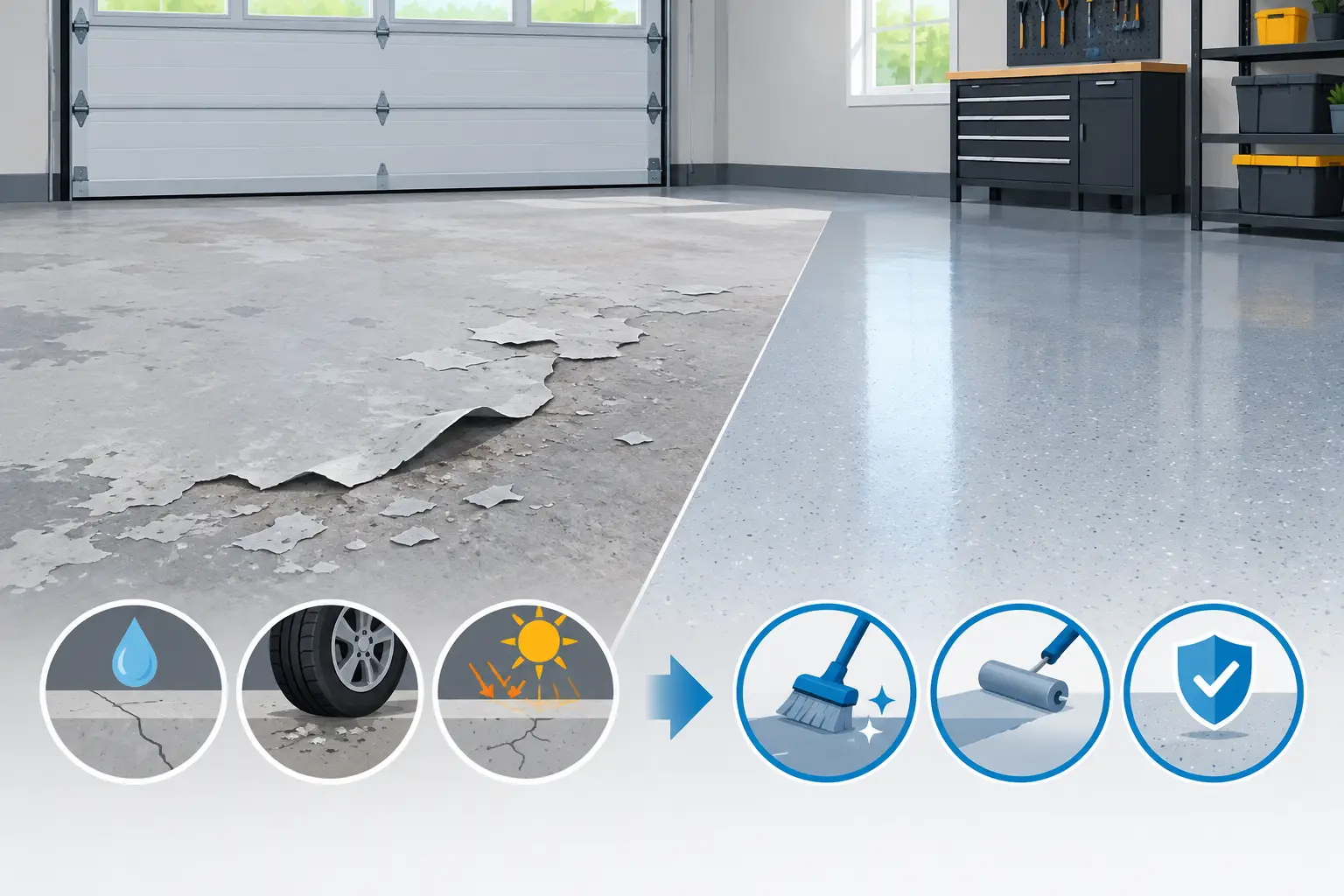
A garage floor can look fine for months, then lift in strips where tires sit, flake near the overhead door, or chip around the edges. If you are asking why garage floors peel, the answer is rarely just “bad paint.” Peeling usually starts below the surface, where moisture, weak adhesion, concrete contamination, or Indiana weather has compromised the bond.
A floor coating is only as dependable as the concrete beneath it and the preparation behind it. The right system can protect a garage from road salt, hot tires, oil, dropped tools, and freeze-thaw cycles. The wrong product – or the right product installed over an unprepared slab – can become another layer that needs to be removed.
Why Garage Floors Peel: The Main Causes
Peeling happens when a coating loses its grip on the concrete. Sometimes the coating itself fails. More often, it was never able to form a strong mechanical bond in the first place. A close look at the failed area can offer clues: coating that comes up cleanly with bare gray concrete underneath points to an adhesion issue, while peeling that brings concrete with it may indicate a weak or deteriorating slab surface.
Moisture moving through the concrete
Concrete is porous. Even a slab that appears dry can hold moisture vapor below the surface. As vapor moves upward, it creates pressure beneath a coating. If that pressure exceeds the coating’s bond strength, the finish can blister, bubble, or peel away.
This is especially common in garages without an effective vapor barrier beneath the slab, in areas with poor drainage, and in homes where melting snow or rainwater regularly enters the garage. Indiana’s wet springs, humid summers, and freeze-thaw winters make moisture testing a practical part of any serious coating evaluation, not an optional extra.
A coating cannot solve an active water problem by itself. Before coating, the installer should identify moisture concerns, examine drainage, and choose a system suited to the slab’s condition. Skipping that work may save time on installation day, but it can cost the floor its long-term performance.
Inadequate surface preparation
Concrete needs a clean, properly profiled surface for a coating to bond. Smooth, hard-troweled concrete may look solid, but it does not automatically provide the texture a high-performance coating needs to anchor itself.
DIY kits and low-cost applications often rely on acid etching or basic cleaning. Those methods may not remove old sealers, curing compounds, embedded oils, tire residue, or weak concrete at the surface. Industrial-grade diamond grinding opens the pores of the concrete and creates a consistent profile for adhesion. It also exposes defects that need repair before coating begins.
Preparation is where durable floors are made. A fast installation should never mean rushed preparation. With the right equipment and trained crew, thorough mechanical prep and a one-day installation can work together.
Oil, grease, sealers, and other contaminants
Garages collect contaminants over time. Motor oil seeps into pores. Tire dressings leave residues. De-icing products, household chemicals, and old acrylic sealers can all interfere with adhesion. Even a new slab may have curing compounds or densifiers that prevent coatings from bonding correctly.
A coating applied over contamination may initially look excellent. The failure often appears later, after temperature changes, vehicle traffic, or moisture expose the weak connection. Peeling in isolated areas – especially under parked vehicles or near the garage entry – frequently points to contamination that was not fully removed.
Road salt and winter exposure
Road salt is hard on unprotected concrete. When salty slush melts off a vehicle, it can soak into the slab and accelerate surface deterioration. The repeated wetting, drying, freezing, and thawing can create scaling, small pits, and weakened concrete near the surface.
If a coating is installed over concrete already damaged by salt, it may peel along with that compromised top layer. This is why concrete repair matters. Cracks, spalls, and salt-damaged areas need to be assessed and repaired before a protective system is installed. Covering them without addressing the underlying weakness does not create a lasting floor.
The wrong coating for the conditions
Not every garage coating performs the same way. Thin, water-based paint products can be easy to roll on, but they are often less resistant to hot tires, chemicals, abrasion, and moisture-related stress than professional systems. Some traditional epoxies can also amber with UV exposure or have narrower installation windows in changing temperatures.
That does not mean epoxy is always the wrong choice. It depends on the application, slab condition, exposure, and performance requirements. For many Indiana garages, a professionally installed polyaspartic system offers distinct advantages: rapid cure times, strong adhesion to properly prepared concrete, UV stability, and resistance to chemicals, salt, and abrasion.
The product matters, but system design matters more. Primer, base coat, decorative flakes or quartz, and protective topcoat must work together as a complete assembly.
How Temperature Changes Make Peeling Worse
Indiana concrete expands and contracts through the year. A garage slab can be cold and damp in January, then warm under sun exposure and hot tires in July. Those shifts place stress on both the concrete and its coating.
When a coating has strong adhesion and the right degree of flexibility, it can handle normal movement much better. When the bond is weak, temperature swings reveal the problem. This is why peeling sometimes seems sudden after a winter season, even though the conditions that caused it were present from the day of installation.
Hot tires deserve special attention. Tires warm up during driving, then transfer heat and pressure to the garage floor when the vehicle is parked. A low-quality coating can soften, pull, or delaminate in these high-stress zones. A properly prepared, industrial-grade coating system is designed to resist that kind of daily use.
How to Tell Whether Your Floor Can Be Recoated
A peeling floor does not automatically need to be replaced, but it does need an honest assessment. Recoating over loose material is not a repair. It simply creates a new coating failure waiting to happen.
The failed coating must be mechanically removed, and the exposed concrete needs to be evaluated for moisture, contamination, cracking, and surface weakness. Small cosmetic defects may be repairable. Extensive moisture intrusion, major spalling, or a failing slab may require additional concrete work before a new coating makes sense.
A professional evaluation should answer practical questions: Is the existing coating failing everywhere or only in isolated areas? Is moisture active? Is the concrete sound enough to hold a new system? What caused the previous failure, and what will be done differently this time? Clear answers help prevent a repeat of the same problem.
What a Long-Lasting Garage Floor Requires
A durable garage floor is not created by applying a thicker coat of paint. It starts with diagnosing the concrete, correcting repair needs, and mechanically preparing the surface. From there, the coating system should be selected for the way the garage is actually used – daily vehicles, workbenches, storage, road salt, chemical exposure, and seasonal changes.
At ARQ Floor Coatings, that approach means treating surface preparation as a performance requirement, not an add-on. A properly installed polyaspartic floor can provide a clean, finished appearance while helping protect the concrete from the conditions Indiana garages see every year.
For homeowners, the goal is a garage that cleans up easily and holds its finish through winter. For commercial properties and high-traffic work areas, it is about reducing maintenance, improving appearance, and protecting the surface beneath ongoing use. In either case, the solution should match the slab, the environment, and the demands placed on it.
If your floor is peeling, do not judge the next option by color samples alone. Ask what caused the failure, how the concrete will be prepared, and how the proposed coating will stand up to moisture, salt, tires, and temperature swings. Those answers are what turn a garage floor from a short-term cosmetic upgrade into protection built to last.