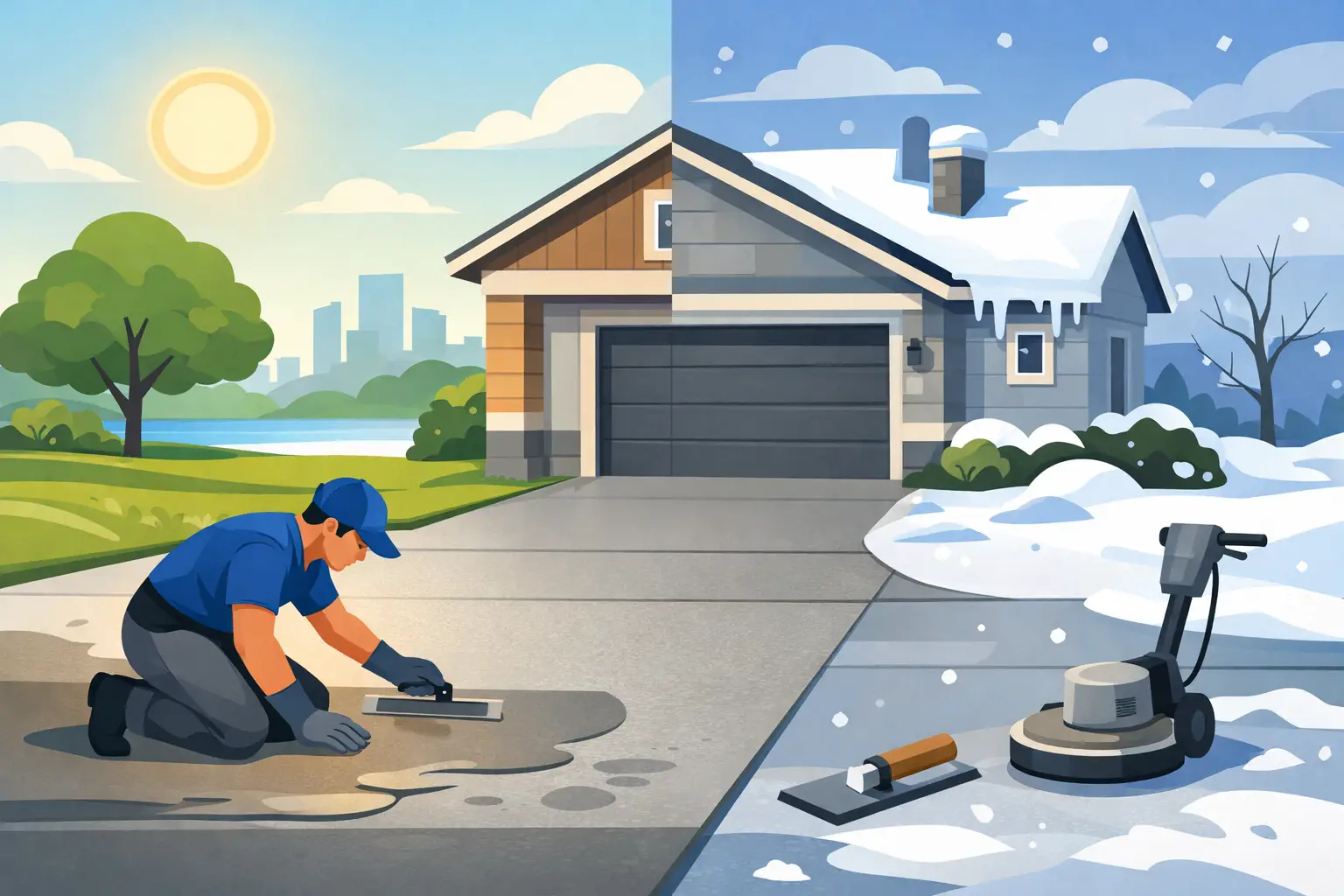
A garage floor can look fine from the driveway and still be failing where it counts. Road salt leaves white residue, hot tires pull at weak finishes, winter moisture works into cracks, and years of use turn bare concrete into a stained, dusty surface. Concrete resurfacing gives Indiana property owners a way to renew that surface without automatically tearing out and replacing the slab.
But resurfacing is not one product or one method. A thin cement overlay, a crack repair, and a high-performance polyaspartic coating all fall under the broad resurfacing label. The right choice depends on what is happening beneath your feet, how the space is used, and how much Indiana weather the surface must handle.
When Concrete Resurfacing Is the Right Answer
Concrete resurfacing makes sense when the slab is structurally sound but its surface has deteriorated. Common signs include staining, light spalling, surface scaling, minor cracking, tire marks, discoloration, dusting, and an uneven or dated appearance. In these cases, removing the entire slab can be expensive, disruptive, and unnecessary.
A properly specified resurfacing system can restore the look of a garage, patio, driveway, pool deck, showroom, restaurant floor, or warehouse while adding practical protection. The result should not simply cover damage. It should create a surface that is easier to clean, more resistant to wear, and better prepared for daily use.
That distinction matters in Indiana. Our slabs see freeze-thaw cycles, humidity, rain, deicing salts, vehicle traffic, and abrupt temperature changes. A cosmetic solution that looks good for a season may fail quickly if it cannot bond to prepared concrete or handle moisture and thermal movement.
Resurfacing is not the right fix for every slab. If concrete is heaving, sinking, severely cracked from movement, or breaking apart deep below the surface, the underlying issue must be addressed first. Coatings and overlays can improve a sound substrate, but they cannot correct a failing foundation, active drainage problem, or major structural movement.
Resurfacing, Overlays, and Coatings Are Not the Same
The word resurfacing often creates confusion because it can describe several approaches. Cementitious overlays add a new layer of material over existing concrete. They can be useful when a surface needs regrading, more substantial cosmetic repair, or a new decorative texture. They also require the right conditions, preparation, and ongoing care.
Protective floor coating systems work differently. Epoxy and polyaspartic systems are engineered to bond to mechanically prepared concrete and form a durable protective layer. For many garages, basements, commercial interiors, and outdoor living spaces, this approach delivers a cleaner finish with stronger resistance to stains, abrasion, chemicals, and moisture exposure.
Polyaspartic technology is especially well suited to demanding Indiana environments. It cures quickly, offers strong adhesion when installed over properly prepared concrete, and is UV-stable for areas exposed to sunlight. That makes it a strong option for garages, patios, walkways, pool decks, and driveways where yellowing, peeling, and weather exposure are real concerns.
The best system is not always the thickest system or the one with the most dramatic color sample. It is the system that matches the slab condition and the job. A warehouse with forklift traffic needs a different specification than a patio around a pool. A restaurant floor may prioritize cleanability and downtime, while a homeowner may need a garage floor that stands up to salt, oil, and hot tires.
Why Preparation Determines Performance
The coating is the visible part of a resurfacing project. Surface preparation is the part that determines whether it stays put.
Concrete naturally holds contaminants. Oil, grease, curing compounds, old paint, sealers, tire residue, and moisture can all interfere with adhesion. Simply pressure washing a slab or rolling a coating onto a smooth floor does not create a reliable bond. That is why professional resurfacing starts with a close assessment of the concrete, followed by industrial-grade mechanical preparation.
Mechanical grinding opens the concrete surface and creates the profile needed for a coating system to anchor properly. Cracks, pits, and damaged areas should then be repaired with materials designed for the purpose. The team must also evaluate moisture concerns, existing coatings, slab condition, drainage, and the edge details that affect the finished appearance.
This work is not glamorous, but it is where long-term value is built. Skipping preparation may save time on installation day, yet it often leads to peeling, bubbling, delamination, or visible failure later. A no-surprise quote should account for the actual condition of the concrete, not assume every slab is ready for a coating straight from the start.
What a High-Performance Coating Adds
A quality coating system does more than make concrete look finished. It changes how the surface performs in daily life.
In a residential garage, a flake polyaspartic floor helps protect the slab from road salt, motor oil, household chemicals, tire marks, and abrasion. Instead of concrete dust collecting along walls and shelves, the floor becomes a sealed, cleanable surface. A homeowner can choose a color blend that complements the home while getting protection built for practical use.
For patios and pool decks, the right coating system can improve appearance and make cleanup easier after rain, pollen, foot traffic, and outdoor entertaining. Texture and finish selection matter here. A surface should be attractive, but it also needs the appropriate traction for wet conditions. The same principle applies to commercial entrances, kitchens, showrooms, and work areas where safety cannot be an afterthought.
Commercial operators also benefit from reduced downtime. Fast-curing polyaspartic systems can often return floors to service quickly, which matters when a restaurant, office, retail space, or warehouse cannot pause operations for days. The exact readiness timeline depends on the application and conditions, but one-day installation is possible for many projects when the substrate and scope are suitable.
Choosing the Right Finish for the Space
A resurfaced floor should fit the way the space works. Decorative flake systems are a popular choice for garages and commercial spaces because they provide depth, help disguise everyday debris, and create a finished appearance without looking overly formal. Solid-color systems offer a clean, modern look for utility areas, offices, and workspaces.
Metallic finishes can create movement and visual impact in showrooms, retail environments, and feature spaces. Quartz systems are often selected where additional durability and texture are needed, including busy commercial settings and outdoor areas. Each finish has different maintenance, traction, and visual characteristics, so choosing by color alone is rarely the best approach.
For example, a bright white garage may look sharp, but a medium flake blend may be more forgiving of Indiana slush and tracked-in debris. A smooth patio finish may be easier to sweep, while a textured option may be better suited to wet-foot traffic near a pool. Good recommendations are specific to the property, not pulled from a one-size-fits-all menu.
What to Expect From a Professional Installation
A dependable concrete resurfacing project begins with an on-site evaluation. The installer should inspect the slab, identify visible damage and potential moisture concerns, ask how the area is used, and explain the available systems in plain language. This is also the time to discuss color, texture, access, curing expectations, and any repairs that may affect pricing.
From there, the work should move through a disciplined process: prepare the substrate mechanically, repair appropriate surface damage, apply the coating system according to the specification, and complete the decorative or protective finish. The final floor should have consistent coverage, clean edges, and a finish selected for its intended environment.
At ARQ Floor Coatings, that process is handled by an in-house team from assessment through installation. Complete project ownership matters because the installer who evaluates the slab should understand exactly what it will take to prepare and protect it. It is how a surface gets engineered to outperform and outlast instead of merely getting covered up.
Protect the Slab You Already Own
Concrete is durable, but exposed concrete is not maintenance-free. Once a slab begins absorbing salt, water, oils, and contaminants, surface damage tends to progress rather than pause. Acting while the concrete is still structurally sound can preserve the slab, improve the property’s appearance, and avoid a larger replacement project later.
The useful next step is not to pick a finish from a photo. Have the concrete evaluated for what it actually needs. With the right preparation, coating technology, and finish for the space, a tired slab can become one of the hardest-working surfaces on the property.